


Beyond the Scent Profile
In industrial perfumery, a candle fragrance oil is far more than a simple scent it is a precisely engineered chemical system designed for performance, stability, and controlled diffusion. At Pahal Wellness, we formulate each blend using advanced fragrance pyramid structuring, where aroma molecules are carefully balanced according to evaporation rate. This ensures consistent cold throw, strong hot throw, and stable burn performance from the first light to the final hour.
For private label brands and bulk candle manufacturers, this level of formulation precision directly impacts product quality and customer satisfaction.
The most critical and often underestimated element of any high-performance candle fragrance oil is the solvent system. At Pahal Wellness, our solvent engineering process ensures that aromatic compounds remain stable and fully compatible with non-polar wax bases such as soy wax, coconut wax, beeswax, and paraffin. Without the correct solvent balance, even premium aroma ingredients fail to integrate properly into the wax matrix, leading to sweating, weak scent throw, flame instability, or soot formation.
As a trusted candle manufacturer, we prioritize solvent compatibility, IFRA Category 12 compliance, and wax-specific performance testing to deliver fragrance oils engineered for commercial-scale candle production.
The Science of Stability: Why Solvents Matter
The central challenge in candle chemistry is the Polar Dilemma. Most high-quality aroma chemicals are polar, requiring a solvent to remain fluid. However, candle waxes whether paraffin or hydrogenated vegetable oils are non-polar hydrocarbons. If a solvent is too polar, the fragrance oil will exceed the wax’s saturation point (typically 10%), causing it to reject the bond.
When this chemical system fails, the maker encounters three primary industrial failures:
- Syneresis (Bleeding): The fragrance oil fails to bind at a molecular level, resulting in “sweating” or liquid pooling on the candle surface.
- Poor Scent Throw: Improper integration prevents molecules from migrating effectively through the melt pool to the wick.
- Flame Disturbances: Incompatible solvents throw off the fuel/air mix, causing the flame to crackle, smoke, or “drown.”
The Physics of Scent Throw The efficacy of scent throw is governed by the relationship between molecular weight and vapor pressure. Volatility is inversely proportional to molecular weight. Lighter molecules, such as Linalool or Limonene, have high vapor pressure and drive the “Cold Throw,” which is essential for the consumer’s purchase-point decision. Conversely, “heavy” molecules with lower vapor pressure, such as Vanillin or synthetic musks, provide the foundation for the “Hot Throw.” A well-chosen solvent manages the kinetic energy of these molecules as the flame creates a molten wax pool, ensuring they vaporize and disperse rather than becoming trapped in the wax matrix.
A Guide to Common Candle Solvents and Their Features
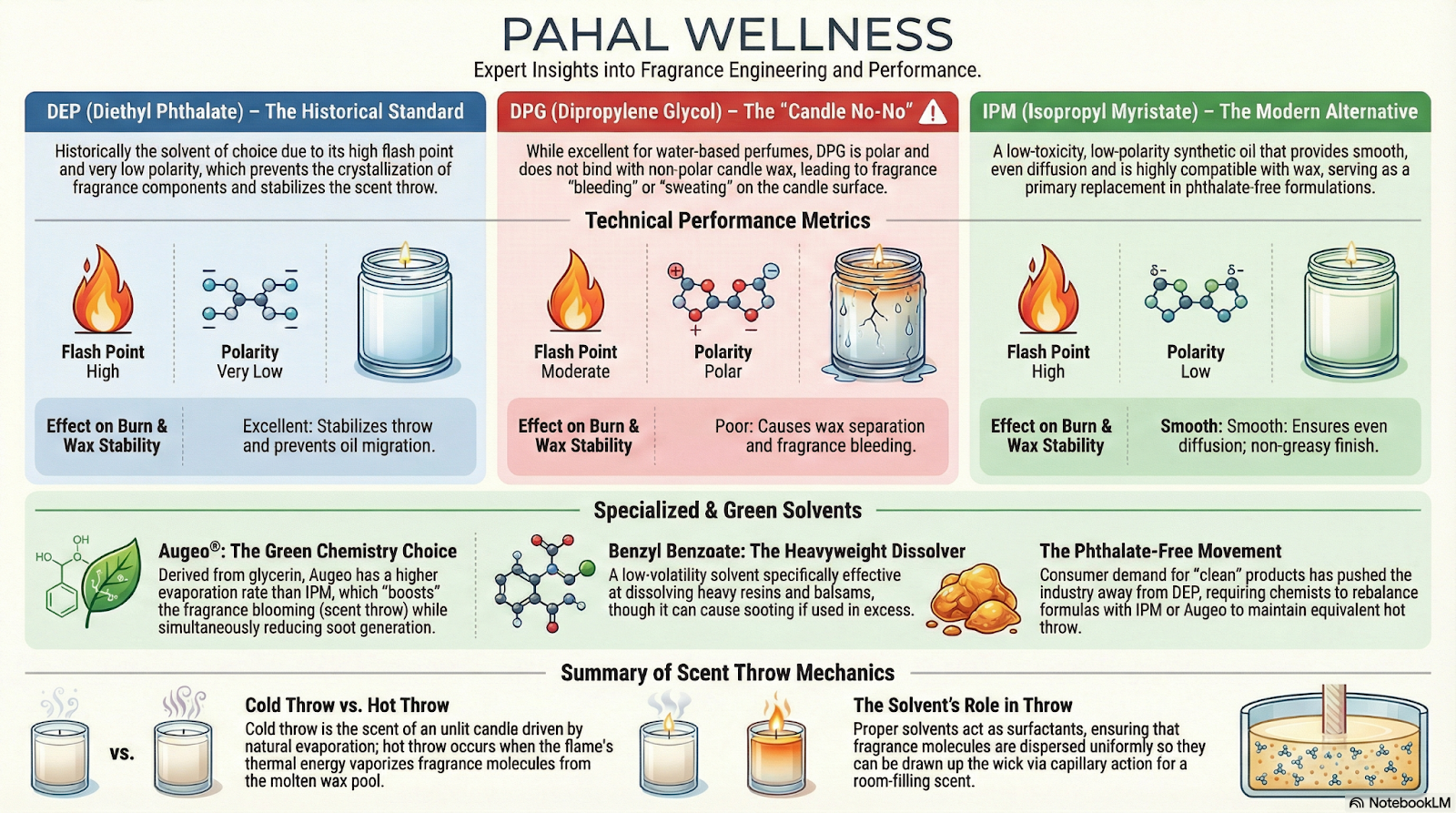
| Solvent Name | Key Feature/Benefit | Polarity Level | Effect on Burn/Throw |
| Diethyl Phthalate (DEP) | Historical industry standard; acts as a blender and surfactant. | Very Low | Excellent; stabilizes throw and prevents crystallization of components. |
| Isopropyl Myristate (IPM) | Synthetic oil; low toxicity; bridges compatibility. | Low | Smooth, even diffusion; commonly used in reed diffusers and lotions. |
| Benzyl Benzoate | Solvent and secondary fixative; dissolves heavy resins/balsams. | Low | High stability; can cause sooting if used in extreme excess. |
| Augeo® | Glycerin-derived “Green Chemistry”; high evaporation rate. | Moderate-Low | Boosts fragrance “blooming”; specifically engineered to reduce soot. |
| Dipropylene Glycol (DPG) | “Candle No-No” | High (Polar) | Failure; leads to wax separation, bleeding, and poor combustion. |
The Supplier “Litmus Test”: Reseller or Manufacturer?
The independent candle maker must be a vigilant gatekeeper. Many suppliers are merely resellers who repurpose fine fragrances (intended for water-based or alcohol-based applications) for candles. These oils often contain high levels of DPG, which is a massive red flag.
To verify if your supplier understands Category 12 (Air Care) engineering, ask these three technical questions:
What is the exact percentage of solvents, specifically DPG, in this formulation? (If the answer is anything but ‘negligible,’ the oil is not engineered for wax.)
If a supplier cannot provide these technical specifics, they are likely a reseller and not the manufacturer. They can also be a reseller but they know about their fragrance oils!
Warning: The Hidden Cost of “Cheap” Fragrance Oils
Diluted fragrance oils represent a false economy. Dilution compromises the “Three C’s” of formulation—Cost, Compatibility, and Cold Throw—which are the North Star of professional perfumery.
- Cost: Diluted oils require a higher fragrance load to achieve parity, often exceeding the wax’s saturation point and increasing the price-per-unit.
- Compatibility: Cheap diluents often lack the non-polar stability required to stay bound within the wax during temperature fluctuations.
- Cold Throw: To save money, diluted oils often skimp on high-impact top notes (citrus, aldehydes). Since consumers decide to buy based on the unlit scent, a weak cold throw ensures your product stays on the shelf.
Conclusion: Crafting with Precision
Superior home fragrance products are not the result of artistic luck; they are the result of strategic chemical engineering. By utilizing high-quality synthetic aroma chemicals and precisely chosen non-polar solvents, you ensure a powerful scent throw, a stable shelf life, and a safe, sootless burn.
To compete in the modern market, you must move beyond the “DIY” mindset. Demand transparency from your fragrance houses, prioritize IFRA 51st Amendment (Category 12) compliance, and master the thermodynamics of your wax-solvent system.
Precision is the only definitive edge. Or, even simpler, approach us to make your scented candle. We will work literally from scratch, developing fragrance oils that are compatible with soy or coconut or beeswax, with complete transparency. Send an email to contact@pahalwellness.com to get started